

What's the Difference Between Microneedling and RF Microneedling?
- Skin 101
- October 4, 2026
- 10 min read
MICRONEEDLING
Table of Contents
- 1. The Short Answer to RF Microneedling vs. Microneedling
- 2. How Traditional Microneedling Works
- 3. What RF Microneedling Adds
- 4. Where RF Microneedling Has a Real Edge
- 5. Where Traditional Microneedling Still Makes Sense
- 6. How Providers Decide Between Them
- 7. Frequently Asked Questions
- 8. Bottom Line
If you’ve been comparing rf microneedling vs microneedling and the explanations you’ve found feel more like marketing than information, you’re not imagining it. Both treatments use needles, both stimulate collagen, and both show up on the same treatment menus, but they’re not interchangeable. Here’s what actually separates them.
1. The Short Answer to RF Microneedling vs. Microneedling
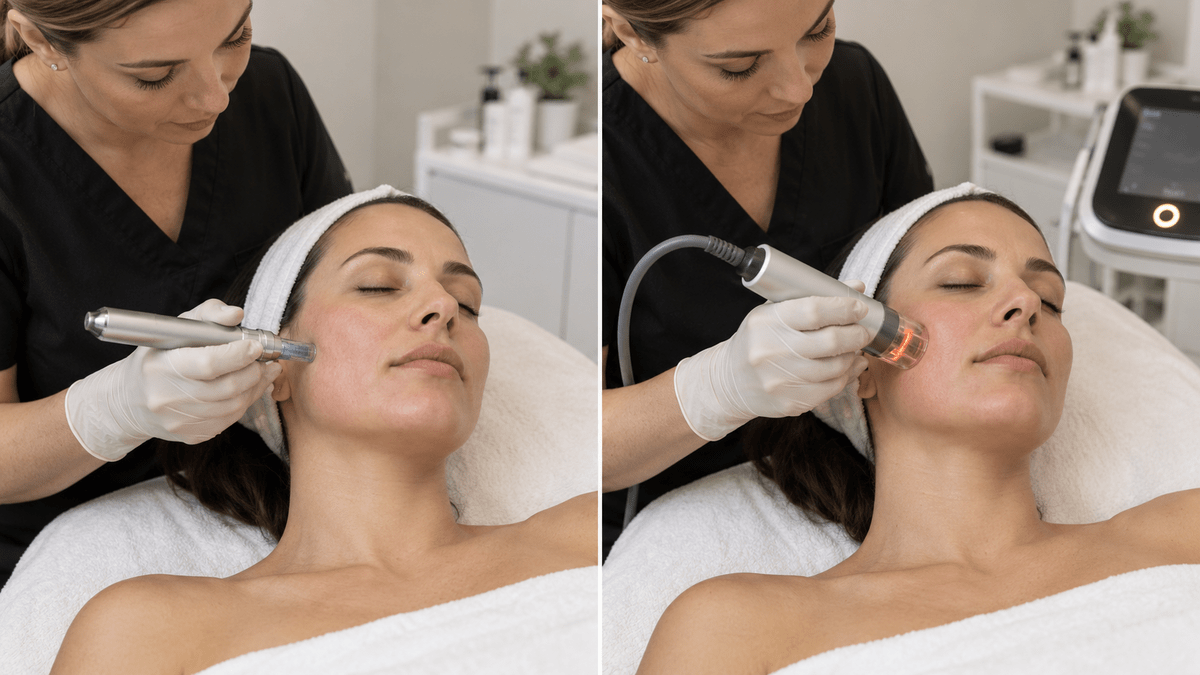
Microneedling creates controlled micro-injuries that trigger your skin to rebuild collagen on its own. RF microneedling does the same thing, but adds radiofrequency energy delivered through the needles, reaching deeper into the skin and adding a heat-based tightening effect that standard microneedling doesn’t produce. The needles are the shared mechanism; the radiofrequency is the actual difference, and it’s the whole reason rf microneedling vs microneedling comes down to more than just picking whichever one sounds more advanced.
That single addition changes more than it might seem to at first. It affects how deep the treatment reaches, what kinds of concerns it’s suited for, how much it typically costs, and even how many sessions a treatment plan tends to require. Understanding that one variable is really the key to understanding everything else that follows.
2. How Traditional Microneedling Works
For a full breakdown of the underlying mechanism, our guide on what microneedling is and how it works covers this in detail, but the short version is that fine, sterile needles create micro-injuries in the skin’s surface layers. This triggers a wound-healing response, and as part of that response, your body produces new collagen and elastin over the following weeks.
This approach works well for concerns rooted in lost collagen closer to the skin’s surface, acne scars, enlarged pores, and general texture irregularities. The mechanism is purely mechanical, the needles themselves do the work of prompting the healing cascade, without any additional energy source involved. Keeping this baseline mechanism in mind makes the rf microneedling vs microneedling comparison much easier to follow, since everything RF adds builds directly on top of this same starting point.
3. What RF Microneedling Adds
This is where the two treatments actually diverge. RF microneedling uses the same needle mechanism, but the needles themselves deliver radiofrequency energy into the deeper layers of skin as they penetrate. According to a clinical study on radiofrequency microneedling published on PMC, this technique is well-established in aesthetic dermatology specifically for its effectiveness in improving skin laxity, fine lines, and overall dermal texture, working by stimulating new collagen formation while minimizing disruption to the skin’s surface layer.
That heat component matters. Where standard microneedling relies entirely on the mechanical injury to trigger healing, RF microneedling adds thermal energy that causes controlled coagulation in the deeper tissue, intensifying the healing and rebuilding response beyond what needles alone produce. This is the core mechanical distinction behind rf microneedling vs microneedling, not a marketing spin, but an actual difference in how each treatment reaches and affects the skin.
The depth control is part of what makes this technology distinct. Providers can typically adjust both the needle depth and the intensity of the radiofrequency energy independently, allowing treatment to be calibrated to a specific concern rather than applying the same settings across every patient.
4. Where RF Microneedling Has a Real Edge
Because RF microneedling reaches deeper and adds a thermal component, it tends to outperform standard microneedling for:
- Skin laxity, since the heat-based tightening effect isn’t something standard microneedling produces on its own
- More established, thicker scar tissue, where deeper energy delivery can help break down tougher scarring
- Combined concerns, where laxity, texture, and scarring overlap and one treatment addressing multiple layers is more efficient than treating each separately
- Areas with more noticeable structural aging, such as jawline or neck laxity, where mechanical needling alone typically isn’t enough to produce visible tightening
RF microneedling is also generally more customizable in terms of depth and energy intensity, allowing providers to adjust the treatment more precisely to a specific concern. This flexibility is a big part of why, in the rf microneedling vs microneedling conversation, RF tends to come out ahead specifically for patients managing more than one concern at once.
5. Where Traditional Microneedling Still Makes Sense
RF microneedling isn’t automatically the better choice for everyone. Standard microneedling remains a strong, often more accessible option for:
- Milder texture and pore concerns that don’t involve significant laxity
- Patients newer to in-office treatment who want to start with a less intensive option
- Situations where budget is a bigger factor, since RF microneedling is typically priced higher given the added technology
- Patients who prefer a treatment with a longer track record and more predictable, well-established downtime
There’s also nothing wrong with standard microneedling simply being sufficient. Not every rf microneedling vs microneedling decision needs to end in favor of the more advanced option, choosing a more intensive treatment than necessary doesn’t produce better results, it just adds cost and recovery time without a proportional benefit.
6. How Providers Decide Between Them
A provider typically weighs a few factors before recommending one over the other:
- Depth of the concern — surface-level texture versus deeper laxity or established scarring
- Treatment goals — general refinement versus more significant tightening or scar remodeling
- Downtime tolerance — RF microneedling can involve slightly more noticeable redness and swelling given the added thermal component
- Budget and session count — RF microneedling may require fewer total sessions for comparable results in some cases, which can offset its higher per-session cost
- Overall skin health and any contraindications — certain skin conditions or medical histories may make one option more appropriate than the other
A consultation is what actually determines which is appropriate, since the same concern can call for a different recommendation depending on severity and skin history. It’s also common for providers to start with a more conservative option and escalate if results plateau, rather than defaulting to the more intensive treatment from the outset.
7. Frequently Asked Questions
Is RF microneedling more painful than regular microneedling?
Sensation levels are generally similar with proper numbing, though some patients report slightly more warmth or heat sensation during RF treatment due to the radiofrequency energy.
Does RF microneedling have more downtime?
Often slightly more than standard microneedling, given the added thermal effect, though it’s still generally minimal, typically a few days of redness and mild swelling.
Is RF microneedling better for acne scars specifically?
It can be more effective for deeper or more established scarring, since the added energy reaches further into the tissue than needles alone. Milder scarring may respond well to either option, which is one of the more common questions that comes up in any rf microneedling vs microneedling discussion.
Can RF microneedling help with skin laxity in ways standard microneedling can't?
Yes, this is one of the clearest differences. The thermal component in RF microneedling produces a tightening effect that standard microneedling isn’t designed to achieve.
Does RF microneedling cost more than standard microneedling?
Typically, yes, given the added technology involved. Some patients offset this with needing fewer total sessions, though total cost still depends on the specific treatment plan.
8. Bottom Line
Rf microneedling vs microneedling isn’t really a question of which is universally better, it’s a question of which matches what your skin actually needs. Standard microneedling remains an effective, more accessible option for surface-level concerns, while RF microneedling’s added thermal energy makes it a stronger fit for deeper laxity, more established scarring, or concerns that overlap across multiple layers of skin.
Neither treatment makes the other obsolete. They’re positioned to handle different depths of the same underlying problem, and the right choice comes down to matching the tool to the concern rather than assuming more advanced automatically means better for every situation.
If you’re weighing the two for your specific skin laxity or scarring concerns, a consultation is the most reliable way to know which treatment, or combination, fits. If you’re in the Houston area, our Houston microneedling page covers what a consultation and treatment plan look like locally.
Key Takeaways
- Both treatments use needles to trigger collagen production, but RF microneedling adds radiofrequency energy for deeper effect
- RF microneedling has a real edge for skin laxity, thicker scarring, and overlapping concerns
- Standard microneedling remains effective and more accessible for milder texture and pore concerns
- RF microneedling typically costs more per session but may require fewer total sessions for comparable results
- Providers often start conservative and escalate treatment intensity if needed, rather than defaulting to the stronger option
- A consultation is the most reliable way to determine which treatment fits your specific skin
PICKING THE RIGHT TREATMENT SHOULDN'T BE A GUESS.
Whether your skin needs the precision of standard microneedling or the deeper reach of RF, the right answer depends on your specific scarring, texture, and laxity, not a general rule. A consultation can tell you exactly which one fits.
Disclaimer: This content is for informational purposes only and does not constitute medical advice. Individual results vary. Consult a licensed provider before beginning any skin treatment.