

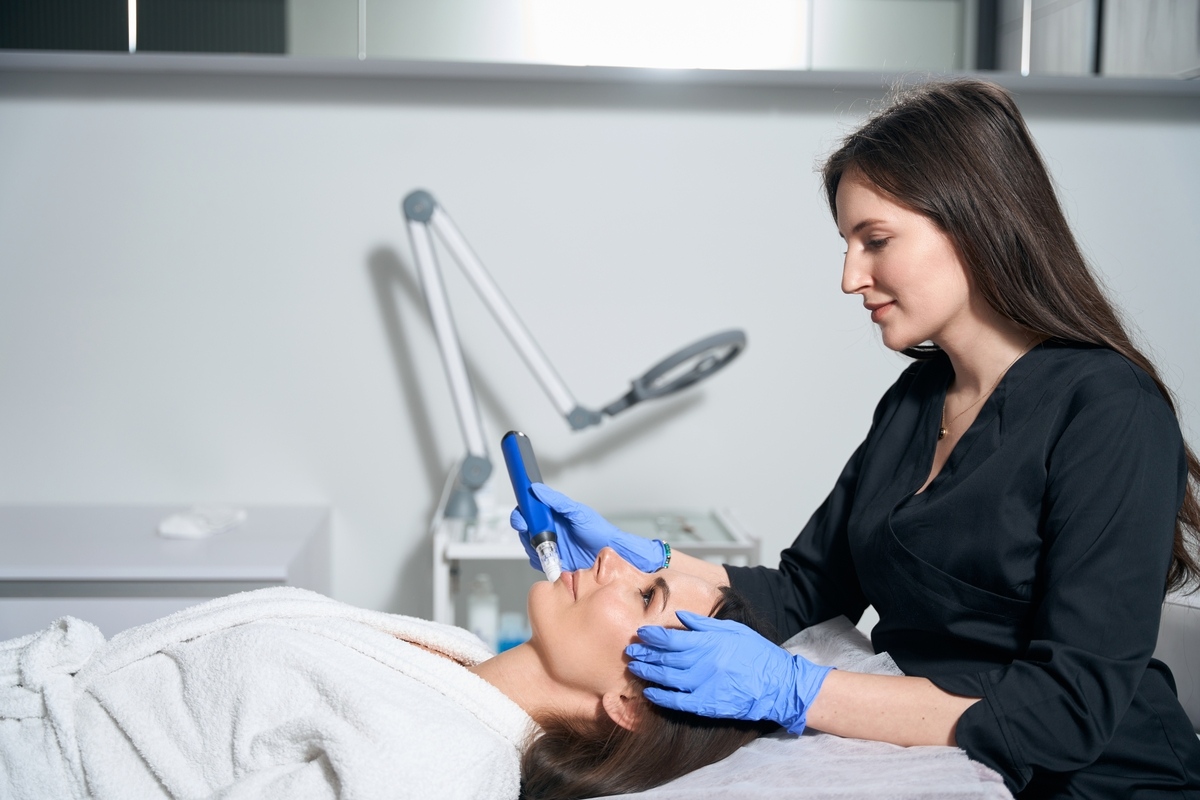
How Does Microneedling Stimulate Collagen Production?
- Skin 101
- September 13, 2026
- 9 min read
ACNE SCAR TREATMENT
Table of Contents
- 1. The Short Version, Before the Science
- 2. What Actually Happens in the First Few Days
- 3. Why Fibroblasts Are the Real Story Here
- 4. The Electrical Theory Behind Microneedling
- 5. Why Results Last Years, Not Weeks
- 6. What This Means for Different Skin Concerns
- 7. Frequently Asked Questions
- 8. Bottom Line
Your skin doesn’t need anything added to it to rebuild itself, it just needs the right signal. Most explanations of microneedling collagen production stop at “it creates tiny injuries that trigger healing.” That’s technically true, but it skips the actual biology, and the biology is what explains why results take weeks to show up and years to fade. Here’s a fuller picture of what’s happening beneath the surface.
That gap in explanation is also why so many people misjudge whether the treatment is working. If you don’t know what’s supposed to be happening internally, it’s easy to assume nothing is going on just because you can’t see it. Walking through the actual mechanism gives you a way to judge progress that isn’t just staring in the mirror after every session.
1. The Short Version, Before the Science
Microneedling collagen production starts with controlled micro-injuries that convince the skin it needs to repair itself. The skin responds the same way it would to any minor injury, by activating a wound-healing cascade. That cascade is where collagen gets made. The needles themselves don’t build anything, they just signal the body to start building.
That distinction matters more than it sounds like it should. The treatment isn’t adding anything foreign to your skin, no product, no filler, no external material staying behind. Everything that ends up improving your skin’s structure is something your own body manufactures in response to a signal. That’s also why the results tend to look and feel natural rather than artificial, the skin isn’t being altered from the outside, it’s being prompted to do work it already knows how to do.
2. What Actually Happens in the First Few Days
The process unfolds in a fairly precise sequence. According to a narrative review of microneedling’s physiological mechanisms, the main effects triggered by microneedling include collagen and elastin production, formation of new blood vessels, and a temporary increase in skin permeability.
Growth factors show up almost immediately. In the first hours after treatment, platelets and neutrophils release growth factors, including transforming growth factor and platelet-derived growth factor, which begin increasing production of the intercellular matrix that supports new tissue.
Fibroblasts get the call to migrate. Within days, monocytes release additional growth factors that ramp up collagen, elastin, and glycosaminoglycan production. This is the point where the skin shifts from responding to actively rebuilding.
3. Why Fibroblasts Are the Real Story Here
Fibroblasts are the cells responsible for actually producing collagen, and they’re the reason microneedling collagen production isn’t instant. According to research on microneedling’s advances and mechanisms, fibroblasts migrate to the site of injury and begin laying down a new intercellular matrix, a process that takes time to organize properly.
Around day five, something structurally important happens. A fibronectin matrix forms from an arrangement of fibroblasts. This matrix is what determines how new collagen gets deposited, meaning the visible improvement you eventually see is the end result of a structural process that started building days earlier, not something that happens in the treatment room itself.
4. The Electrical Theory Behind Microneedling
This part surprises most people. Beyond the wound-healing response, some researchers propose that microneedling works partly through a change in cellular electrical activity. A cell’s resting membrane potential sits around negative 70 millivolts. When a needle approaches the membrane, that potential shifts to around negative 100 millivolts, which appears to trigger increased cell activity and the release of growth factors and proteins.
Under this theory, the needles aren’t necessarily creating a wound in the traditional sense, they’re triggering a cellular response that behaves as though an injury occurred, prompting fibroblast migration and collagen induction without necessarily requiring visible tissue damage. Research in this area is still developing, but it adds another layer to why microneedling collagen production works even at conservative needle depths.
5. Why Results Last Years, Not Weeks
This is the detail that surprises people most: the collagen laid down through this process isn’t temporary. Once the fibronectin matrix organizes new collagen deposition, that collagen, specifically Collagen III, remains in place and gradually tightens over a period researchers estimate at five to seven years before it naturally degrades.
That timeline is part of why microneedling is positioned as a longer-term investment in skin structure rather than a quick fix. The visible improvement in texture and firmness reflects collagen that’s actually integrated into the skin, not a surface effect that fades within weeks.
6. What This Means for Different Skin Concerns
Understanding the mechanism explains why microneedling collagen production applies to a range of concerns rather than just one:
- Acne scars improve as new collagen fills in areas where collagen was lost during original healing
- Fine lines and early aging soften as collagen and elastin production restore some of the structural support skin loses over time, a concern also addressed on our fine lines and wrinkles page
- Skin laxity benefits from the same tightening effect as new collagen organizes, covered in more depth on our skin laxity page
- Dull, dehydrated-looking skin often improves as increased blood vessel formation supports better nutrient delivery to the treated area, which we cover further on our dull or dehydrated skin page
Every one of these outcomes traces back to the same underlying mechanism, not a different process for each concern.
7. Frequently Asked Questions
How long does it take for microneedling to start producing collagen?
Growth factor activity begins within hours, and the fibronectin matrix that organizes new collagen forms around day five. Visible improvement typically develops over several weeks as this process continues.
Does deeper needling produce more collagen?
Needle depth needs to match the concern being treated. Deeper isn’t automatically better, it needs to be calibrated to the treatment area and goal, which is part of why in-office treatment differs from at-home devices.
How long does the new collagen actually last?
Research estimates the collagen deposited through this process remains in place for approximately five to seven years before naturally degrading, though ongoing maintenance sessions are common to sustain results.
Is microneedling collagen production the same as what happens with dermal fillers?
No. Fillers add volume directly rather than triggering your body to produce its own collagen. Microneedling works by prompting your own collagen synthesis, which is why results build gradually rather than appearing immediately.
Why do results take weeks to show up instead of being immediate?
Because collagen has to be produced, organized, and integrated into the skin structure, a biological process that simply takes time, rather than something that happens instantly during treatment.
8. Bottom Line
Microneedling collagen production isn’t just “tiny needles trigger healing,” it’s a multi-stage biological process involving growth factor release, fibroblast migration, matrix formation, and possibly a cellular electrical response, all working together to rebuild collagen that can remain in place for years. Understanding that process is what makes the gradual timeline make sense, and why consistency across a treatment plan matters more than any single session.
If you’re curious how this applies to your specific skin concern, our guide on microneedling covers what a treatment plan actually looks like, and a consultation is the most direct way to find out what your skin needs.
Key Takeaways
- Microneedling triggers a wound-healing cascade that leads fibroblasts to migrate and produce new collagen
- A fibronectin matrix forms around day five, determining how new collagen gets deposited
- Some research suggests microneedling also works through a change in cellular electrical activity, not just physical injury
- New collagen from this process can remain in place for an estimated 5 to 7 years
- The same mechanism explains improvement across acne scars, fine lines, skin laxity, and dull skin
YOUR SKIN IS ALREADY BUILDING. LET'S GUIDE IT.
Collagen production doesn’t need to be a mystery you’re guessing at. A consultation can look at what your skin actually needs, whether that’s rebuilding scarring, softening fine lines, or restoring firmness, and build a plan around your body’s own repair process.
Disclaimer: This content is for informational purposes only and does not constitute medical advice. Individual results vary. Consult a licensed provider before beginning any skin treatment.