

What Are Ice-Pick Scars and How Are They Treated?
- Skin 101
- August 20, 2026
- 8 min read
ACNE SCAR TREATMENT
Table of Contents
If a provider has ever told you that you have ice pick scars and you weren’t totally sure what that meant, you’re not alone. The name sounds dramatic, but it’s actually a precise clinical description, and understanding what it describes is the first step toward knowing what will actually help.
It’s also one of the more commonly misunderstood scar types, partly because the name gets used loosely online to describe almost any small, deep-looking mark. Clinically, though, it refers to something specific: a particular shape, depth, and cause that sets it apart from other acne scars. Getting that distinction right matters, since the treatment that works well for one scar type can do very little for another.
1. What Makes a Scar an "Ice-Pick" Scar
Ice pick scars get their name from their shape: narrow, deep, and sharply defined, like the skin was pierced by a small, pointed object. According to a comprehensive review of atrophic acne scar treatments published on PMC, ice pick scars are vertical, V-shaped depressions less than 2mm wide that can extend through the entire thickness of the dermis, and in some cases even deeper.
That depth is the defining feature. A scar can be small at the surface and still reach much further down than it appears, which is part of why these scars are often underestimated at a glance.
2. Why Ice-Pick Scars Form
The cause traces back to how the original breakout healed. Ice pick scars typically develop after severe, deeply inflamed acne, cystic breakouts in particular, that damage the skin at a level too deep for normal healing to fully repair. When the skin’s healing response can’t rebuild enough collagen to fill that damage, the result is a narrow channel of lost tissue rather than a smooth, healed surface.
This is also why ice pick scars are more associated with untreated or severe acne than mild breakouts. The deeper the original inflammation, the more tissue loss the skin has to recover from.
3. How Ice-Pick Scars Differ From Boxcar and Rolling Scars
All three are classified as atrophic scars, meaning they form from collagen loss rather than excess. But their shape and depth differ meaningfully:
- Ice pick scars are narrow (under 2mm), sharply defined, and extend deep into the skin in a V-shape
- Boxcar scars are wider, with defined vertical edges and a flatter base, generally shallower than ice pick scars
- Rolling scars are the widest of the three but shallowest, creating a wavy, undulating texture rather than a defined pit
According to the same PMC review, ice pick scars are actually the most common type of atrophic acne scarring, making up roughly 60 percent of cases, followed by boxcar scars at about 25 percent and rolling scars at 15 percent.
4. Why They're the Hardest Acne Scar Type to Treat
Depth is the whole problem. Because ice pick scars extend so far into the skin relative to how narrow they are at the surface, treatments that work well on shallower, broader scars often can’t fully reach the bottom of an ice pick scar. A treatment that smooths the surface without addressing the depth will leave the core of the scar largely unchanged.
This is why ice pick scars frequently require either a more targeted approach or a combination of treatments, rather than one single method being sufficient on its own.
5. What Treatment Actually Involves
Common approaches used for ice pick scars include:
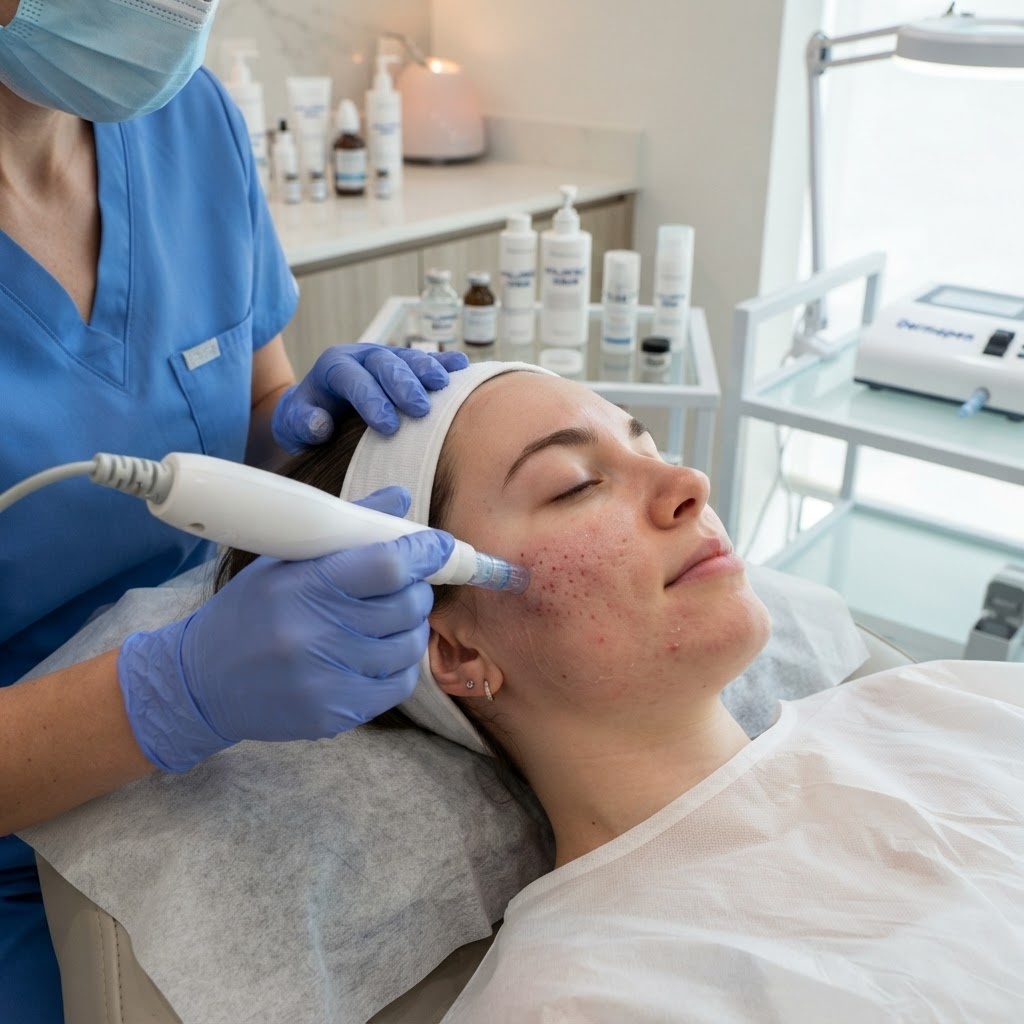
- Microneedling, which stimulates new collagen production in the treated area and works well when performed in a series to build depth improvement gradually
- Chemical peels, which can improve surrounding texture and tone, though depth-focused improvement typically needs to be paired with a treatment that reaches deeper
- Punch excision, a more targeted in-office procedure sometimes used for isolated, especially deep ice pick scars
- Combination treatment plans, since no single approach reliably addresses both the depth and surrounding texture on its own
A consultation is what determines which of these, or which combination, is appropriate, since scar depth varies significantly even within the ice pick category.
6. What to Expect From Treatment
Improvement in ice pick scars tends to be more gradual than improvement in shallower scar types, simply because there’s more depth to rebuild. Multiple sessions are typically needed, and results build progressively rather than resolving after one visit. Some ice pick scars respond well enough to non-invasive treatment alone, while more established or unusually deep scars may benefit from combining approaches.
7. Frequently Asked Questions
Can ice pick scars be completely removed?
Complete removal isn’t always realistic, but meaningful improvement in depth and visibility is achievable for most patients, particularly with a treatment plan matched to the scar’s depth.
Are ice pick scars permanent if untreated?
Yes, generally. Unlike some post-acne discoloration that fades naturally over time, structural scarring like this doesn’t resolve without treatment.
What's the best treatment for ice pick scars specifically?
There isn’t one universal answer, treatment depends on how deep and how numerous the scars are. A combination approach is common for more established ice pick scarring.
How is an ice pick scar different from a large pore?
Pores are a natural skin feature; ice pick scars are deeper, narrower, and don’t follow the regular pattern pores do. A provider can usually distinguish the two easily on close examination.
Do ice pick scars get worse with age?
They don’t typically worsen structurally, but natural collagen loss with age can make existing scarring more visually noticeable over time.
8. Bottom Line
Ice pick scars are defined by their depth, not just their appearance, and that depth is exactly why they’re considered the hardest acne scar type to treat effectively. Understanding what’s actually happening beneath the surface, and why surface-level treatments alone often fall short, is what makes it possible to choose an approach that actually reaches the problem.
Our broader guide to acne scar treatment options covers how ice pick scars compare to other treatment approaches in more depth, and microneedling is one of the most commonly used treatments for this scar type specifically. If you’re in the Houston area, you can also read more about acne scar treatment locally and what a consultation involves.
Key Takeaways
- Ice pick scars are narrow, V-shaped, and can extend deep into the skin, deeper than they may appear at the surface
- They’re the most common type of atrophic acne scarring, making up roughly 60 percent of cases
- Their depth is what makes them harder to treat than boxcar or rolling scars
- Microneedling, chemical peels, punch excision, and combination approaches are all used depending on scar depth
- Improvement builds gradually across multiple sessions rather than a single visit
KNOWING THE SCAR IS ONE THING. TREATING IT IS ANOTHER.
Ice pick scars go deeper than they look, which is exactly why guessing at treatment rarely works. A consultation can assess your scars’ actual depth and build a plan around what will genuinely reach them.
Disclaimer: This content is for informational purposes only and does not constitute medical advice. Individual results vary. Consult a licensed provider before beginning any skin treatment.